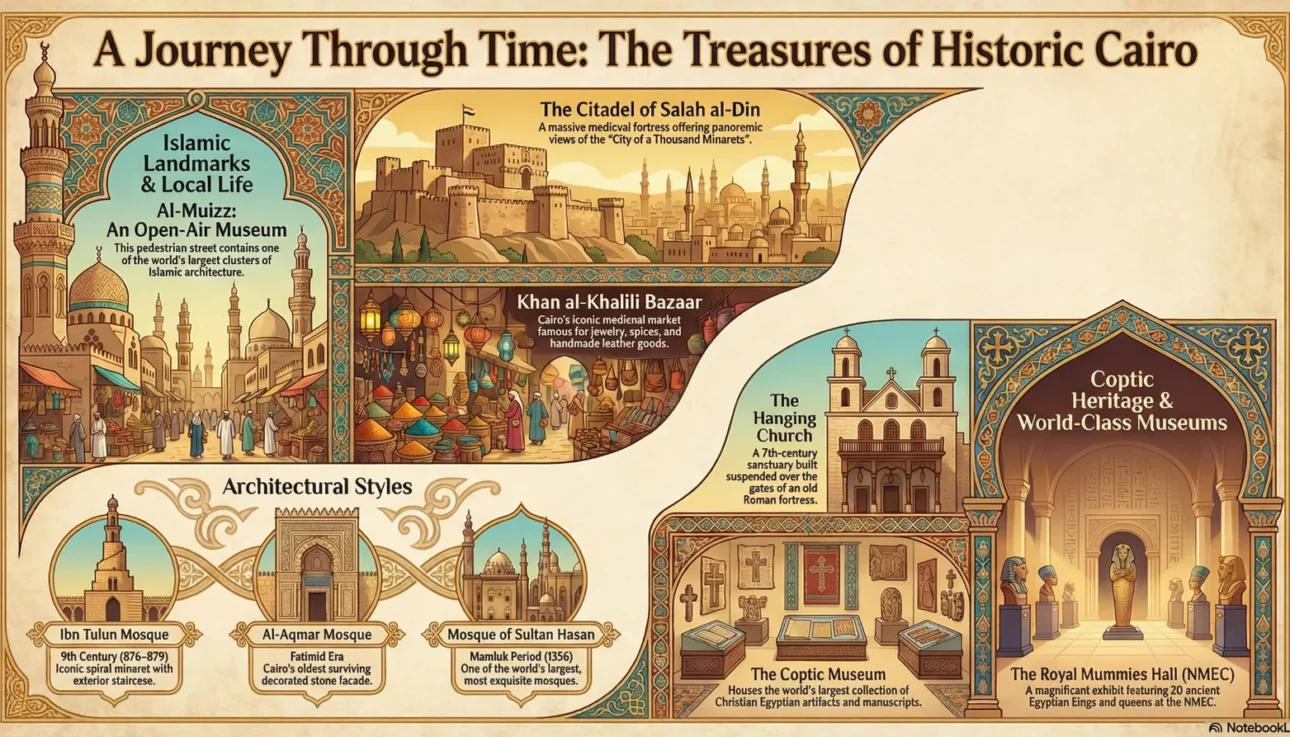
Imagine stepping off the busy streets of modern Cairo and winding your way into a maze of narrow alleys where minarets pierce the sky and shopkeepers call out over piles of spices. That feeling of slipping through a crack in time is exactly what you experience in Historic Cairo. This district founded in the 10th century and later the beating heart of the Islamic world hides among today’s skyscrapers historyhit.com. It was inscribed as a UNESCO World Heritage Site in 1979 historyhit.com, and it’s easy to see why: the eastern bank of the Nile is home to over 600 monuments and buildingsdating from the 7th to the 20th centuries historyhit.com.
Walking through Historic Cairo is like leafing through pages of a living history book. Bab al Futuh and Bab Zuweila, two of the city’s 11th‑century gates, still watch over the old neighbourhood historyhit.com. In between them runs Al‑Muizz Street, a pedestrian-friendly stretch lined with some of the world’s finest Islamic architecture experienceegypt.eg. You’ll pass mosques, madrasas and palaces representing eras from the Fatimid period to the Muhammad Ali dynasty experienceegypt.eg. The street brushes up against Khan al‑Khalili Bazaar, where you can sip mint tea, bargain for brass lamps and watch craftsmen hammer copper the way they have for generations. Each turn offers a new surprise: the elegant Bayt al‑Suhaymi with its wooden mashrabiya screens experienceegypt.eg, the towering mosque of Sultan Hassan, or the Coptic Hanging Church perched on the remains of a Roman fortress experienceegypt.eg.
While Historic Cairo feeds the soul with its centuries-old atmosphere, Egypt’s newest attraction engages your sense of wonder on a monumental scale. After two decades of construction and about a $1 billion investment, the Grand Egyptian Museum (GEM) threw open its doors to the public in November 2025 aljazeera.com. Sitting just 2 km from the pyramids of Giza and 8 km from Cairo aljazeera.com, the museum’s chamfered triangular silhouette has already earned it the nickname of the “fourth pyramid”aljazeera.com. Inside, this 500,000‑sq‑metre complex houses more than 100,000 ancient artefacts aljazeera.com.
The museum’s grand foyer is anchored by a 3,200‑year‑old statue of Ramses II; the 83‑tonne colossus had to be transported upright along a 30 km route to reach its new home aljazeera.com. Beyond, visitors can wander through 12 permanent exhibition halls that trace Egypt’s history from prehistory through the Greco‑Roman era aljazeera.com. Highlights include the Tutankhamun Gallery, a 7,500‑square‑metre hall displaying over 5,000 objects from the boy king’s tomb ljazeera.com, and a 4,500‑year‑old boat that once ferried Pharaoh Khufu’s spirit to the afterlife aljazeera.com. The design, by Irish architects Heneghan Peng, aligns the museum’s walls with the Great Pyramid of Khufu and the Pyramid of Menkaure and wraps the structure in translucent alabaster and frosted glass aljazeera.com. With conservation labs, gardens and an on‑site conference centre, the GEM is more than a museum it’s a cultural campus poised to protect Egypt’s treasures for the future.
Together, Historic Cairo and the Grand Egyptian Museum offer travellers two sides of the same coin: one a living cityscape where each cobblestone tells a story, the other a state‑of‑the‑art showcase for artefacts spanning seven millennia. Wander through the medieval alleyways in the morning, then spend your afternoon in the cool halls of the GEM marvelling at Tutankhamun’s golden mask. In a single day, you’ll experience the continuity of a civilisation that still thrives between minarets and display cases – a reminder that in Egypt, the past is never truly past.